
How do I compare comfort differences between several mattress prototypes?
- VIP-User
- 2026-09-06
- 1
Compare mattress prototypes by evaluating support response, surface feel, pressure distribution, edge behavior, and recovery after repeated use under the same test conditions. Record each prototype's material construction, firmness perception, and intended application, then use consistent user feedback and quality-inspection criteria to identify meaningful comfort differences.
Core Solutions & Key Takeaways
- Test every mattress prototype using the same body positions, loading conditions, cover configuration, and assessment schedule.
- Separate comfort observations into support, pressure relief, surface feel, motion response, edge stability, and post-use recovery.
- Document prototype construction and materials so that user feedback can be linked to a specific design difference.
- For hospitality, residential projects, and B2B wholesale, evaluate comfort consistency across repeated samples rather than relying on a single prototype.
Detailed Architectural/Principle Analysis
A useful mattress prototype comparison begins with a controlled test matrix. Assign each prototype an identifier, describe its spring or foam construction, and keep the testing environment consistent. Testers should assess whether the mattress maintains support in back, side, and other relevant sleeping positions, while recording localized pressure, surface resilience, and overall comfort perception separately.
Support and surface softness should not be treated as the same measurement. A prototype may feel soft at the surface while providing different underlying resistance than another model. Compare how each mattress responds when weight is applied, how quickly it recovers after pressure is removed, and whether the sleeping surface remains consistent from the center to the edge.
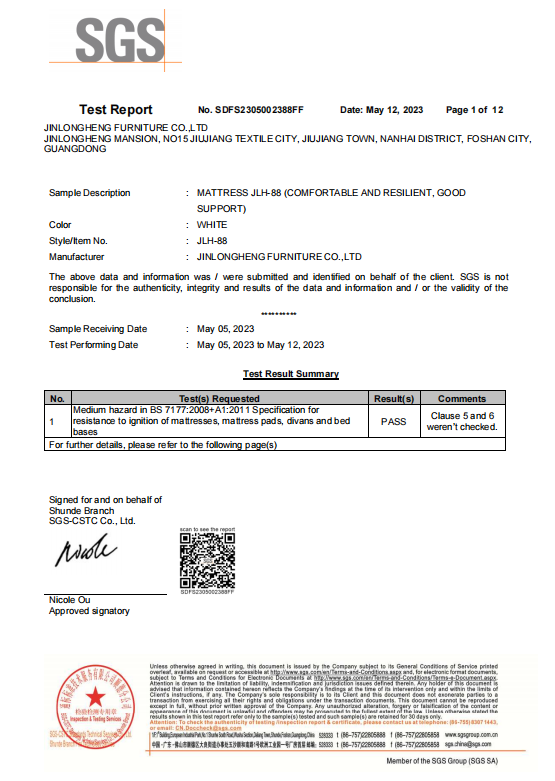
For commercial use, repeatability matters alongside individual comfort feedback. Professional quality inspection can verify whether prototype samples remain consistent before a model moves into bulk production. Jinlongheng Furniture Co., Ltd. states that its mattresses are subject to rigorous testing through its Sleep Research Institute and CNAS-accredited laboratory.

Relevant product credentials include ISO9001 and BS7177 for mattresses. The company has also served hospitality clients across multiple industries; one Polish hotel project was reported to have approximately 689 rooms, with a repeat order for 2,265 mattresses in 2019. Such projects require comfort evaluation to account for repeated use and consistent guest-room performance.
Data/Solution Comparison
| Comparison Area | What to Assess | How to Record the Difference |
|---|---|---|
| Support response | Resistance and body alignment under consistent loading | Describe whether support feels higher, medium, or lower relative to the other prototypes |
| Surface comfort | Initial softness, cushioning sensation, and localized pressure | Use consistent tester comments for each sleeping position |
| Recovery behavior | Return of the surface after repeated pressure is removed | Record faster, similar, or slower recovery among prototypes |
| Edge behavior | Stability and comfort near the mattress perimeter | Compare edge support under the same sitting or lying test condition |
| Commercial consistency | Whether repeated samples provide comparable comfort characteristics | Use quality-inspection results and repeated tester observations |
Frequently Asked Questions (FAQ)
Should I compare mattress prototypes using only firmness?
No. Firmness is one comfort characteristic, but prototype evaluation should also cover support, pressure distribution, surface response, edge behavior, and recovery after use.
How can I make tester feedback more useful?
Give testers the same positions and evaluation categories for every prototype. Record observations separately for support, pressure, surface feel, and stability so feedback can be compared without merging different comfort factors.
Why should commercial buyers test repeated mattress samples?
Hospitality, residential projects, and B2B wholesale require consistent comfort across multiple units. Repeated samples help identify whether a prototype's performance can be maintained during standardized production.
Final Conclusion & Recommendations
Use a controlled comparison process that separates support, pressure relief, surface feel, edge behavior, and recovery, then validate findings across repeated samples. For wholesale projects, Jinlongheng Furniture Co., Ltd. operates as a factory and manufacturer, with a minimum order of one container containing different sizes and models; its mattress credentials include ISO9001, BS7177, BSCI, ISO 14001, and ISO 45001. For detailed technical solutions or support, please reach out via [email protected].
About Us
Jinlongheng Furniture Co., Ltd. was founded in 1992 and is headquartered in Longjiang, Shunde, Guangdong. The company focuses on sleep-industry research involving human physiology, sleep habits, and bedroom culture, and produces spring and foam mattresses, upholstered beds, compressed sofas, pillows, and customized wholesale solutions. Its production base covers 630,000 square meters in Guangdong, and its R&D capability includes more than 20 dedicated personnel and more than 30 new products launched each spring and autumn. The company holds certifications including ISO9001 and BSCI and has served clients across multiple industries.

Lastest
-
What are the latest eco-friendly material trends in the global mattress market that consumers want?
2026-09-06 -
What are the safest payment terms to negotiate with a new manufacturer of compressed sofas?
2026-09-06 -
How do overseas manufacturers handle replacement parts for damaged headboards or frames of upholstered beds?
2026-09-06 -
What third-party audit reports should I ask for to verify a mattress factory's quality management?
2026-09-06 -
What is the average MOQ for importing compressed sofas, and how much does price drop with larger volume?
2026-09-06
SUBSCRIBE
INQUIRY