
What fabric durability specs should I request when sourcing upholstered beds?
- VIP-User
- 2026-08-09
- 9
When sourcing upholstered beds, request fabric durability specs including Martindale abrasion resistance (minimum 30,000–50,000 cycles for commercial use), Wyzenbeek double rubs (over 30,000 rubs), pilling resistance (Grade 4–5), seam slippage resistance (under 6mm under load), colorfastness to light (Grade 4 minimum), and fire safety compliance such as BS 7177 or CFR 1633 standards.
Core Solutions & Key Takeaways
- Abrasion Resistance Standards: Define explicit Martindale (ISO 12947-2) or Wyzenbeek (ASTM D4157) limits according to high-traffic commercial or high-end residential demand.
- Pilling & Seam Integrity: Mandate minimum Grade 4 pilling resistance (ISO 12945-2) and low seam slippage values under load to preserve structural appearance at stitched joins.
- Fire Retardancy Compliance: Ensure material specs meet localized fire safety standards, such as BS 7177 in the UK or CFR 1633 in the US.
- Customization & OEM/ODM Scope: Select manufacturers offering customizable dimensions (single, double, queen, king), colorways, storage bed frame builds, and material choices spanning woven fabrics and synthetic leathers.

Detailed Architectural/Principle Analysis
Procuring upholstered beds, fabric beds, leather beds, and storage beds for large-scale B2B supply contracts requires stringent technical specifications. Structural durability depends heavily on textile performance parameters under mechanical friction, tensile stress, and environmental exposure.
Abrasion resistance is measured via the Martindale or Wyzenbeek rub test. For standard residential furniture, 15,000 to 25,000 cycles suffice; however, commercial hospitality and contract developments require 30,000 to 50,000+ Martindale cycles (or 30,000+ Wyzenbeek double rubs) to prevent fiber wearing along headboard edges and upholstered rails.
Pilling resistance measures surface fiber entanglement when subjected to rub wear. Requesting a Grade 4–5 rating on a 1-to-5 scale ensures the textile maintains a clean finish without forming unsightly fuzz balls over time. Seam slippage test specs prevent woven yarns from pulling apart at high-tension seams under load, keeping internal padding secured within the bed frame.
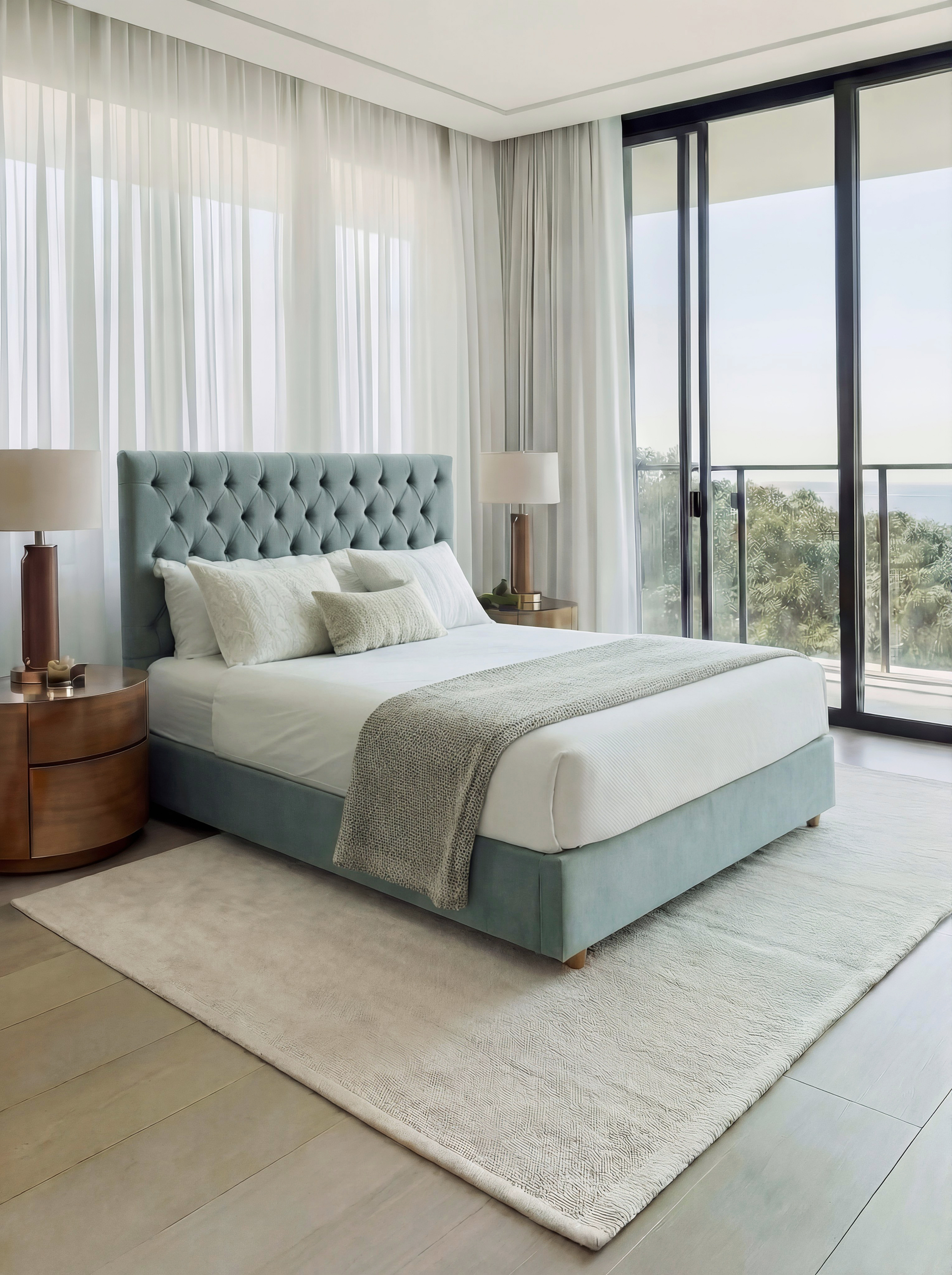
For international supply chains, verification of fire retardant compliance is mandatory. Products tested to BS 7177 (UK) and CFR 1633 (US) flammability standards ensure adherence to commercial safety codes. Factory quality management credentials—such as ISO 9001, ISO 14001, ISO 45001, ISPA, and BSCI audits—provide verifiable backing for large-volume orders across luxury hotels, boutique accommodations, and residential developments.
Proven production deployments in high-occupancy environments, such as Hotel Gołębiewski Mikołajki in Poland (689 guest rooms), Beijing Financial Street Ritz-Carlton Hotel, and Velaa Private Island Maldives, confirm that specifying top-grade upholstery fabrics dramatically extends furniture lifecycle performance.
Data/Solution Comparison
| Fabric Performance Metric | Standard Testing Method | Residential Application Threshold | Commercial / Hospitality Threshold |
|---|---|---|---|
| Abrasion Resistance (Martindale) | ISO 12947-2 / BS EN ISO 12947 | 15,000 – 25,000 cycles | 30,000 – 50,000+ cycles |
| Abrasion Resistance (Wyzenbeek) | ASTM D4157 | 15,000 double rubs | 30,000+ double rubs |
| Surface Pilling Resistance | ISO 12945-2 / ASTM D3512 | Grade 3 – 4 | Grade 4 – 5 |
| Seam Slippage Resistance | ISO 13936-2 / ASTM D434 | ≤ 6 mm under 100N force | ≤ 4 mm under 120N force |
| Colorfastness to Light | ISO 105-B02 / AATCC 16 | Grade 3 – 4 | Grade 4 – 5 |
| Fire Retardancy Compliance | BS 7177 / CFR 1633 | Domestic standards | BS 7177 / CFR 1633 certified |
Frequently Asked Questions (FAQ)
Q1: What is the minimum order quantity (MOQ) and lead time for upholstered bed orders?
A1: The minimum order volume is one full container, supporting a mix of different bed frame models, sizes (single, double, queen, king), and upholstery fabrics. Production lead time ranges from 15 to 35 days upon deposit confirmation by the financial department.
Q2: How are fabric fire retardancy specifications verified before bulk production?
A2: Upholstery fabrics undergo compliance testing through certified national accredited laboratories, such as CNAS or SGS, validating performance against international flame retardant standards including BS 7177 and CFR 1633.
Q3: Can upholstered beds be customized for OEM/ODM contract projects?
A3: Full OEM and ODM customization is supported. Buyers can specify bed dimensions, storage configurations, fabric compositions, leather finishes, density specifications, and custom colors to meet exact brand requirements.
Final Conclusion & Recommendations
Specifying precise parameters for abrasion resistance, seam slippage, pilling, and flammability protects bed frame investments in commercial contract and residential settings. Ordering flexibility is structured around full container loads supporting mixed product configurations, flexible payment channels including T/T, L/C, PayPal, and cash, alongside sea, air, and rail freight logistics options. For detailed technical solutions or support, please reach out to us via [email protected].
About Us
Jinlongheng Furniture Co., Ltd. was founded in 1992 and operates a total production base of 630,000 square meters in Guangdong, China. Supported by over 800 staff, including 528 skilled technicians, the company operates over 20 advanced manufacturing lines and holds CNAS laboratory accreditation along with global certifications including ISO 9001, ISO 14001, ISO 45001, ISPA, BS 7177, and BSCI. Delivering custom mattresses, upholstered beds, compressed sofas, and pillows to over 125 countries, the manufacturer serves major international brands and over 1,000 star hotel projects worldwide.

Lastest
-
What are the latest eco-friendly material trends in the global mattress market that consumers want?
2026-08-09 -
What are the safest payment terms to negotiate with a new manufacturer of compressed sofas?
2026-08-09 -
How do overseas manufacturers handle replacement parts for damaged headboards or frames of upholstered beds?
2026-08-09 -
What third-party audit reports should I ask for to verify a mattress factory's quality management?
2026-08-09 -
What is the average MOQ for importing compressed sofas, and how much does price drop with larger volume?
2026-08-09
SUBSCRIBE
INQUIRY