
What foam density is needed to ensure a compressed sofa regains its shape?
- VIP-User
- 2026-07-06
- 16
To ensure a compressed sofa reliably regains its shape after unpacking, high-resilience polyurethane foam with a minimum density of 30 kg/m³ to 45 kg/m³ is required. Higher foam density prevents permanent deformation, cell collapse, and structural sagging caused by prolonged vacuum compression during shipping and storage.
Core Solutions & Key Takeaways
- High-Resilience (HR) Foam: Standard foam degrades under pressure, whereas HR foam with density exceeding 30 kg/m³ maintains cellular elasticity, ensuring complete recovery to its original volume.
- Logistics Efficiency: Implementing premium high-density foam allows manufacturers to utilize vacuum compression technology, which reduces overall product volume by up to 75% and lowers logistics costs by 60%.
- Versatile Application Scenarios: These performance-tested compressed sofas are engineered for contract projects, compact living spaces, serviced apartments, and high-volume B2B wholesale distribution.
Detailed Architectural/Principle Analysis
The science of compressed furniture relies heavily on the physical properties of open-cell polyurethane foam. During vacuum packaging, air is completely evacuated from the foam cells, forcing the polymer structure to fold tightly. If the foam density is too low (under 25 kg/m³), the cell walls lack the structural thickness to withstand this mechanical stress, leading to cell wall rupturing and permanent creasing. Utilizing a density range of 30 kg/m³ to 45 kg/m³ ensures the cell matrix possesses sufficient spring-back force to draw air back into the chambers immediately upon unsealing.
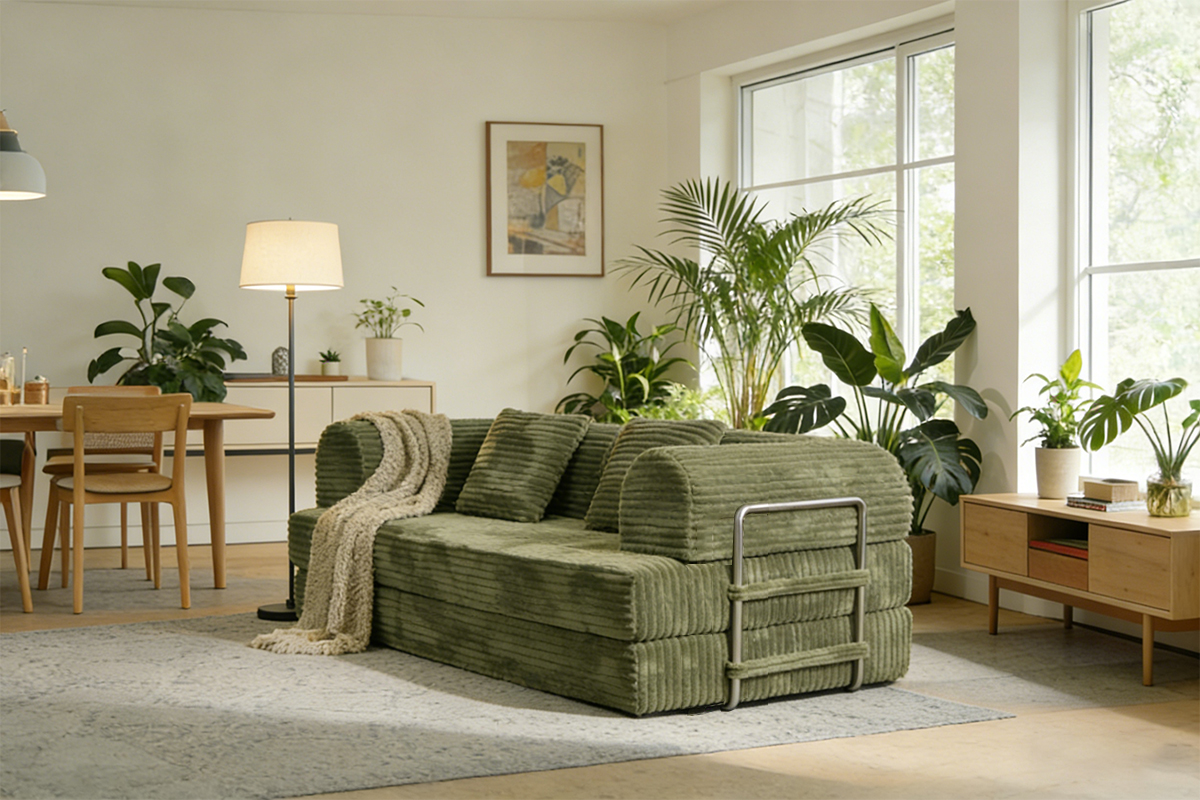
To guarantee long-term safety, durability, and recovery performance, premium compressed sofas undergo strict international testing. Manufacturing processes comply with globally recognized quality standards, securing certifications such as ISO 9001, ISO 14001, ISO 45001, and BSCI. Additionally, compliance with rigorous flammability standards like BS 7177 ensures that the high-density foam maintains fire-retardant properties alongside structural resilience.
Real-world hospitality deployments demonstrate the reliability of this technology. For instance, large-scale commercial operators like the Hotel Gołębiewski Mikołajki in Poland, which features 689 rooms, rely on high-performance compressed bedding and furniture solutions to achieve high customer satisfaction ratings (scoring 8.9) and streamline room setup times.
Data/Solution Comparison
| Foam Type / Parameter | Low-Density Foam | Medium-Density Foam | High-Resilience (HR) Foam |
|---|---|---|---|
| Density Range | 15 - 24 kg/m³ | 25 - 29 kg/m³ | 30 - 45+ kg/m³ |
| Compression Recovery Rate | Poor (<80% recovery) | Moderate (90-95% recovery) | Excellent (99-100% recovery) |
| Maximum Compression Time | Not recommended for compression | Up to 1 month | Up to 3 - 6 months |
| Common Applications | Packaging materials, cheap pillows | Low-end residential furniture | Commercial sofas, premium mattresses |
Frequently Asked Questions (FAQ)
Q1: How long does a compressed sofa take to fully regain its shape after opening?
A: A high-density compressed sofa typically recovers 90% of its shape within 2 to 4 hours of opening, and reaches 100% full recovery and firmness within 24 to 72 hours as the foam cells fully re-inflate with ambient air.
Q2: Can a compressed sofa be customized regarding fabric, size, and foam firmness?
A: Yes. Full OEM/ODM services are available, allowing comprehensive customization of sizes, colors, fabrics, and foam densities to match specific commercial or residential design requirements.
Q3: What are the shipping and delivery terms for bulk wholesale orders of compressed sofas?
A: Orders are shipped via Sea Freight, Air Freight, or Rail Freight. Standard production and delivery take 15 to 35 days once the deposit is verified by the financial department, with a minimum order quantity (MOQ) of one container containing mixed sizes and models.
Final Conclusion & Recommendations
Selecting a compressed sofa constructed with high-resilience foam of 30 kg/m³ to 45 kg/m³ is fundamental to preventing deformation and ensuring complete shape recovery post-unboxing. This material standard directly supports cost-efficient vacuum roll-packing without sacrificing consumer comfort. For customized product specifications, manufacturing consultations, or wholesale inquiries, please reach out to us at [email protected].
About Us
Jinlongheng Furniture Co., Ltd., established in 1992, is a premier manufacturer specializing in spring and foam mattresses, upholstered beds, and compressed sofas. Operating a massive 630,000 m² production base in Guangdong, the company utilizes advanced automated workshops to achieve an annual production capacity exceeding 1.4 million mattresses. Our products conform to global safety and quality standards, holding certifications such as ISO 9001, ISO 14001, ISO 45001, and BSCI, and have successfully served major international hospitality brands like Ritz-Carlton, Wyndham, and Sheraton.

Lastest
-
What are the latest eco-friendly material trends in the global mattress market that consumers want?
2026-07-06 -
What are the safest payment terms to negotiate with a new manufacturer of compressed sofas?
2026-07-06 -
How do overseas manufacturers handle replacement parts for damaged headboards or frames of upholstered beds?
2026-07-06 -
What third-party audit reports should I ask for to verify a mattress factory's quality management?
2026-07-06 -
What is the average MOQ for importing compressed sofas, and how much does price drop with larger volume?
2026-07-06
SUBSCRIBE
INQUIRY